

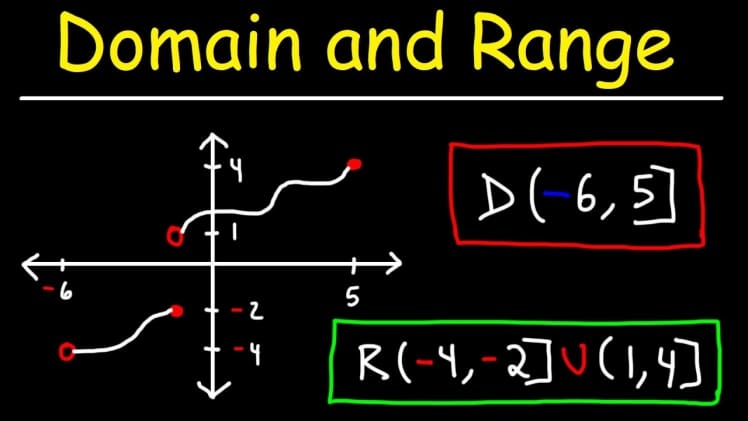
In the vast realm of mathematics, graphs are powerful tools that visually represent relationships between variables. Whether it’s a simple linear function or a complex polynomial, understanding the domain and range of a graph is essential for grasping the behavior and limitations of a mathematical expression. In this exploration, we embark on a journey to unravel the secrets of graphs and unveil the methods to determine their domain and range.
The Basics of Functions and Graphs
At the heart of finding the domain and range lies the concept of functions. A function, in mathematical terms, is a rule that assigns each element from one set, called the domain, to exactly one element in another set, known as the codomain. The collection of all possible output values forms the range of the function.
Graphs serve as visual representations of functions, offering insights into their behavior. Before delving into the intricacies of domain and range, it’s crucial to understand the anatomy of a graph. The horizontal axis, often labeled as x, represents the input values, while the vertical axis, labeled as y, signifies the corresponding output values.
Understanding Domain and Its Constraints
The domain of a function is the set of all possible input values (x-values) for which the function is defined. In other words, it encompasses the range of values that can be plugged into the function to produce a valid output. The nature of the function and any associated constraints dictate the domain.
Continuous Functions
For continuous functions, which have no breaks or interruptions in their graphs, the domain typically spans all real numbers. Linear functions, quadratic functions, and cubic functions are examples of continuous functions with unrestricted domains.
Consider the simple linear function �(�)=2�+3f(x)=2x+3. In this case, the domain is all real numbers since the function is defined for any value of x.
Functions with Restrictions
However, functions may have restrictions that narrow down their domains. For instance, square root functions (�(�)=�f(x)=x) are defined only for non-negative values of x since the square root of a negative number is not a real number.
Similarly, rational functions (�(�)=1�f(x)=x1) have restrictions on the values of x for which the function is defined. The denominator cannot be zero, so any value of x that makes the denominator zero must be excluded from the domain.
Navigating the Range of Functions
While the domain deals with the input values, the range is concerned with the output values (y-values) produced by the function. It represents the set of all possible results that the function can yield. Understanding the behavior of a function’s graph is crucial in determining its range.
Identifying Range through Graphical Analysis
Graphical analysis provides an intuitive way to identify the range of a function. By visually inspecting the highest and lowest points on the graph, one can deduce the range.
Consider a simple parabolic function �(�)=�2f(x)=x2. The graph of this quadratic function opens upwards, and its minimum point is at the vertex of the parabola. By examining the graph, it becomes evident that the range is all real numbers greater than or equal to zero.
Algebraic Methods for Range Determination
For more complex functions, algebraic methods can be employed to determine the range. Understanding the behavior of the function, identifying critical points, and considering limits can provide insights into the possible range.
Take the cubic function �(�)=�3−3�2f(x)=x3−3x2. By factoring the function as �(�)=�2(�−3)f(x)=x2(x−3), we can see that the function crosses the x-axis at �=0x=0 and �=3x=3. These points are critical in understanding the behavior of the function. By analyzing the sign of �(�)f(x) in the intervals created by these critical points, we can determine that the range is all real numbers.
Special Cases: Piecewise Functions
In some instances, functions are defined differently in distinct intervals. These are known as piecewise functions. Finding the domain and range of piecewise functions involves considering the rules governing the function in each interval.
For example, consider the piecewise function:
x^2 & \text{if } x < 0 \\ 2x + 1 & \text{if } x \geq 0 \end{cases}
In this case, the function is defined differently for �<0x<0 and �≥0x≥0. By considering the behavior of each segment separately, we can determine the overall domain and range of the piecewise function.
Advanced Techniques: Analyzing Transcendental Functions
Transcendental functions, which include trigonometric, logarithmic, and exponential functions, often exhibit unique characteristics in terms of domain and range.
Trigonometric Functions
Consider the sine function �(�)=sin(�)f(x)=sin(x). The domain of this function is all real numbers, and the range is constrained between -1 and 1. Trigonometric functions exhibit periodic behavior, and understanding the periodicity is crucial in determining the range.
Logarithmic and Exponential Functions
Logarithmic and exponential functions also have specific characteristics. For the logarithmic function �(�)=ln(�)f(x)=ln(x), the domain is �>0x>0, and the range is all real numbers. Conversely, for the exponential function �(�)=��f(x)=ex, both the domain and range encompass all real numbers.
Summary: A Holistic Approach to Domain and Range
In conclusion, finding the domain and range of a graph is a nuanced process that requires a holistic understanding of the function’s behavior, constraints, and specific characteristics. From continuous functions with unrestricted domains to piecewise functions and transcendental functions with unique properties, each category demands a tailored approach.
Mastering the art of finding the domain and range not only enhances one’s mathematical proficiency but also deepens the appreciation for the elegance and diversity of mathematical expressions. As we unravel the secrets of graphs, we discover a world where mathematical functions, like pieces of a puzzle, come together to form a beautiful and interconnected tapestry—one that invites exploration, analysis, and a profound understanding of the underlying principles that govern our mathematical universe.
