

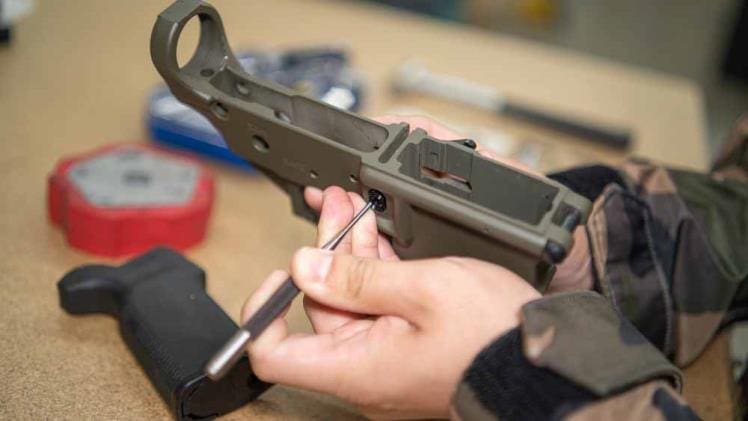
Today, you will learn how to install your bottom parts kit for the AR-15, one of the most frequently used semi-automatic rifles in the USA.
This article includes detailed directions for installing the AR15 lower parts kit, which includes the trigger, hammer, safety selector, and other crucial pieces.
Before you begin, ensure you have all the necessary tools, including a hammer, a set of punches, a vise, and a lower receiver vise block. You might also need a torque wrench and thread locker, depending on the utilized kit.
Step 1 – Safety, Safety, Safety!
As you should always do when handling firearms, make sure the weapon is not loaded, and your workspace is secure before you begin. Check the magazine and chamber to ensure there are no loaded rounds. For protection, put on gloves and safety glasses.
Remove the takedown and pivot pins from the upper receiver to disassemble the lower receiver. Take away the spring, buffer, and buffer tube next. Finally, take the lower receiver’s grip and trigger guard off.
Step 2 – Magazine Catch Installation
The magazine catch, the release button for the magazine catch, and the magazine button spring are required for this phase of AR15 lower parts kit installation.
To start, release the magazine catch on the receiver’s left side. Next, place the spring on top of it and the magazine release button on the lower receiver’s right side.
Punch the spring located behind the magazine release button. The magazine catch button should then be screwed onto the threaded end. Adjust the button’s tightness so that it is snug but not too tight.
Step 3 – Safety Selector Installation
For this stage, you’ll need a pistol grip and screw, a lever for the safety detector, a detent, and a spring.
Place your safety selector in the lower receiver, attach the pistol grip without overtightening it, and then lower the detent until it points upward.
Step 4 – Trigger Installation
The installation procedure may vary depending on the trigger type (drop-in or mil-spec). Simply drop the trigger housing into the trigger pocket and attach the locking pins to secure it there to install the drop-in trigger.
Before being installed in the lower receiver, the mil-spec trigger requires extra assembly. You need to depress the disconnector and line up the hole in the disconnector with the hole you can see in the trigger bar after inserting the lower trigger portion into the lower receiver trigger pocket.
The hammer and spring should then be attached, and the hammer should then be inserted using a punch into the final hole of the lower receiver. After that, swap it out for a pin from the opposing side.
Step 5 – Bolt Catch Installation
You need a bolt catch lever, a rolling pin, a plunger, and a spring. This could be the hardest step in the process. Put the spring and plunger into the bolt catch hole to start. Only half-hammer the roll pin on the side to make room for the bolt catch lever.
Line up the hole with the bottom receiver pinhole by pressing the bolt catch lever downward. The roll pin must be firmly inserted until the edge of the receiver hole is flush with it.
Step 6 – Buffer System Installation
You will need a mil-spec buffer tube, a buffer spring, a buffer weight, an end plate, a castle nut, a detent, and a spring for the takedown pin in order to install the buffer kit.
First, slide the rear takedown through the holes to ensure that it is seated. In the little hole on the back face of the lower receiver, insert the detent and spring. Press it firmly into the end plate using a tiny flathead screwdriver to secure the spring in place.
Apply pressure to the end plate while you tighten it with the castle nut. If you want it to stay put, you can tighten it with an armorer’s wrench. By striking a punch downward onto the nut, you can permanently pin it in place.
Step 7 – Takedown Pins
The front takedown pin can be added after the rear takedown pin. This time, the detent is added after the spring has been installed. To make the task easier, use a small, flat screwdriver.
Step 8 – Trigger Guard Installation
Trigger guards for AR 15 forged lower receivers must be purchased separately. The fact that this component is simple to install is a plus. The component and a screwdriver are all that is required. Install the screws on the right and left sides of the sight and set it.
Step 9 – Test Your Rifle
After putting everything together, test the AR 15 to make sure it works. The magazine catch, safety selector, and trigger must all be checked for this.
Make sure the trigger can be reset and the safety selector can be moved easily before going from the safe to the firing position. Test the magazine hatch button to make sure the magazine engages and releases properly.
After these checks, perform a function test with snap caps or dummy rounds before you load actual .223 ammo. This will ensure that the rifle is operating correctly and safely.
Step 10 – Final Touches
Before using your AR 15, make careful to perform a final inspection. Check to make sure all of the screws are in place, and the pins are tightened in line with the manufacturer’s recommendations.
You can apply a thread locker on the screws and pins to prevent them from corroding over time. It might occur when the gun rattles and recoils.
Before continuing, the lower receiver and trigger need to be cleaned and lubricated. Make sure the parts are well-oiled before using them to reduce friction and ensure smooth operation.
Conclusion
When you have the right information and resources at your disposal, installing the AR 15 lower parts kit is a rather simple task.
Always remember that safety comes first when handling a firearm and that before making any modifications or installs, you should always read the manufacturer’s instructions.
